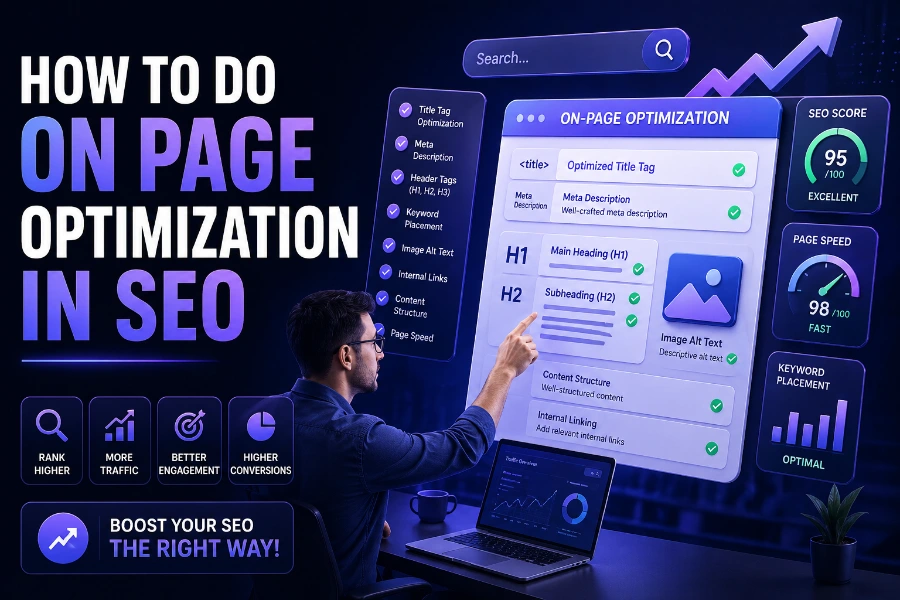
On-page SEO is the foundation of every high-ranking website, and mastering it gives you full control over how search engines understand your content. When you optimize correctly, you improve visibility, user experience, and conversion potential without relying heavily on backlinks.
In this guide, you will learn how to do on-page optimization in SEO step by step, using strategies that actually work today. By the end, you will have a complete system you can apply to any page to consistently improve rankings and traffic.
On-Page SEO And Why It Matters
On-page SEO refers to all optimization techniques you apply directly to your website pages to improve search engine rankings. These include content quality, keyword placement, page structure, internal linking, and technical performance.
When you focus on these elements, you make it easier for search engines to crawl and understand your content while also improving user experience. This combination is what drives long-term rankings and sustainable organic traffic.
Modern SEO is no longer about stuffing keywords but about creating helpful, structured, and relevant content that satisfies search intent. When you align your page with what users actually want, search engines reward your effort with better visibility.
If you want to scale content creation efficiently, understanding how to get high-quality copy written with AI fast becomes valuable, and tools that help you get high-quality copy written by AI quickly can help you produce optimized content without sacrificing quality.
Conducting Keyword Research The Right Way
Keyword research is the starting point of any successful on-page SEO strategy. You need to identify what your audience is searching for and how competitive those keywords are.
Instead of focusing only on high-volume keywords, you should target a mix of primary, secondary, and long-tail keywords. This approach helps you capture both broad and specific search traffic.
Search intent is equally important because it determines how you structure your content. If users want information, you provide detailed explanations, and if they want solutions, you focus on actionable steps.
Types Of Keywords To Target
- Primary keyword for the main topic
- Secondary keywords for context
- Long-tail keywords for specific queries
Using this layered approach ensures your page ranks for multiple variations while staying relevant to the topic.
Optimizing Content For Search Intent And Quality
Content quality is the backbone of on-page SEO, and it directly affects how long users stay on your page. High-quality content answers questions clearly while providing actionable insights.
You should structure your content so that it matches user intent from the first paragraph. This means addressing the main question quickly and then expanding with useful details.
Search engines now prioritize helpful content that demonstrates expertise and trustworthiness. This is why shallow or generic articles struggle to rank, even if they are optimized technically.
Understanding how AI improves content workflows is also essential, and insights from how AI helps with online content creation show how automation can support research, drafting, and optimization without replacing human input.
Writing SEO Friendly Titles And Meta Descriptions
Your title tag is one of the most important ranking factors and also influences click-through rates. A well-optimized title includes the target keyword while remaining clear and engaging.
Meta descriptions do not directly affect rankings, but they play a huge role in attracting clicks. A compelling description should summarize the page and encourage users to take action.
Both elements should align with the page’s content to avoid misleading users. Consistency between search results and actual content improves trust and reduces bounce rates.
If you are exploring content generation tools, understanding 5 reasons CopyGenai is the best AI writing assistant can help you produce optimized titles and descriptions efficiently.
Structuring Content With Headers And Formatting
Headers help search engines understand the structure of your content while making it easier for users to read. Proper use of H1, H2, and H3 tags improves both SEO and readability.
Each section should focus on a specific subtopic, and headers should clearly describe what the section covers. This helps search engines match your content to relevant queries.
Formatting also plays a role in engagement because users prefer content that is easy to scan. Breaking text into smaller paragraphs improves readability and keeps users on the page longer.
Best Practices For Headers
- Use one H1 per page
- Include keywords naturally in H2S
- Keep headings descriptive and clear
Optimizing URLs For Better Rankings
URLs are often overlooked, but they play an important role in on-page SEO. A clean, descriptive URL helps both users and search engines understand the page’s content.
You should include your primary keyword in the URL while keeping it short and readable. Avoid unnecessary words or complex structures that make the URL harder to understand.
Using hyphens to separate words improves readability and ensures search engines can correctly interpret the URL. A simple structure also increases the likelihood that users will click your link.
Internal Linking Strategy For SEO Growth
Internal links help distribute authority across your website and guide users to related content. This improves both SEO performance and user experience.
When linking internally, use descriptive anchor text that clearly explains the destination page. This helps search engines understand the relationship between pages.
A strong internal linking strategy also increases the time users spend on your website. The longer users stay, the stronger the signal you send to search engines about content quality.
Optimizing Images And Media Content
Images enhance user experience but must be optimized to avoid slowing down your website. Proper optimization ensures faster loading times and better SEO performance.
You should use descriptive file names and include alt text that reflects the content of the image. This helps search engines understand visual elements and improves accessibility.
Compressing images without reducing quality is essential for maintaining performance. Faster pages rank better and provide a smoother experience for users.
Improving Page Speed And Performance
Page speed is a critical ranking factor, especially for mobile users. Slow-loading pages increase bounce rates and reduce overall engagement.
You can improve speed by optimizing images, minimizing code, and using caching techniques. These changes significantly enhance performance without affecting content quality.
A fast website not only improves rankings but also increases conversions. Users are more likely to stay and interact with content when pages load quickly.
Mobile Optimization And User Experience
Mobile optimization is no longer optional because most users access websites through mobile devices. A responsive design ensures your content looks good on all screen sizes.
You should focus on readability, navigation, and loading speed for mobile users. These factors directly impact user satisfaction and search rankings.
Search engines prioritize mobile-friendly websites, making it essential to test and optimize your pages regularly. A seamless mobile experience improves both SEO and user engagement.
Using Schema Markup For Better Visibility
Schema markup helps search engines understand your content more clearly. It can also improve how your page appears in search results through rich snippets.
Adding structured data allows search engines to display additional information like ratings, FAQs, and product details. This increases visibility and click-through rates.
While not mandatory, schema provides a competitive advantage when used correctly. It enhances both user experience and search engine understanding.
Tracking Performance And Making Improvements
SEO is not a one-time task but an ongoing process that requires monitoring and adjustments. Tracking performance helps you identify what works and what needs improvement.
You should use tools like Google Analytics and Search Console to analyze traffic, rankings, and user behavior. These insights guide your optimization efforts.
Continuous improvement ensures your content stays relevant and competitive. Regular updates help maintain rankings and adapt to changing search trends.
Common On Page SEO Mistakes To Avoid
Many websites fail to rank because of simple but costly mistakes. Avoiding these errors can significantly improve your SEO performance.
Overusing keywords, ignoring search intent, and neglecting mobile optimization are common issues. These mistakes reduce content quality and harm rankings.
You should also avoid duplicate content and poor internal linking. Fixing these problems creates a strong foundation for long-term SEO success.
Conclusion
Learning how to do on page optimization in SEO gives you a powerful advantage in building a successful website. When you focus on content quality, structure, and technical performance, you create pages that both users and search engines appreciate.
The key is consistency because small improvements across multiple pages can lead to significant results over time. By applying the strategies in this guide, you can improve rankings, increase traffic, and build a strong online presence that continues to grow.